Defining Your Brand’s Voice: How to Create Powerful Content Profiles for Writing Assistant
Are you a Conductor customer?
Review this article—and the rest of our educational content and activities—in our in-platform Community!
Not a customer? Click here to view this article
In today's content-driven world, a clear and consistent brand voice is more important than ever. But what happens when you need to scale content creation, especially with AI? How do you ensure every article, blog post, and landing page sounds authentically like you?
Enter Content Profiles in Conductor's Writing Assistant.
Content Profiles are a powerful feature designed to consolidate your brand's unique voice, style, and rules into a centralized hub. This allows Conductor's AI to act as a true extension of your brand, generating content that is consistently aligned with your identity.
This guide will walk you through best practices for creating effective Content Profiles.

Think of a Content Profile as a container for your brand's content guidelines. It's where you codify the key elements of your brand's voice, tone, target audience, and compliance requirements for the AI to follow.
By setting up Content Profiles, you can:
Ensure Consistency: Every piece of AI-generated content will adhere to your brand's specific guidelines.
Increase Efficiency: Eliminate the need to repeatedly provide instructions for tone, style, and exclusions for every new draft.
Scale with Confidence: Produce high-quality, on-brand content at scale, knowing it will reflect your unique identity with minimal manual editing for brand alignment.

A Content Profile is comprised of three key areas:
Voice and Tone, Audience, and Usage Rules. Here’s how to approach each section.
1️⃣ Defining Your Voice and Tone
This section is where you describe the "what" and the "how" of your brand's personality. Don't worry about the technical difference between "voice" and "tone"; instead, focus on providing as much detail as possible about how your brand should sound.
To get started, consider these questions:
What are the core characteristics of our brand? Are you playful or serious? Formal or casual? Authoritative or conversational?
What is our brand's mission and values? How can we reflect these in our writing?
How do we want our audience to feel when they read our content? Inspired, informed, reassured, or something else?
Are there specific writing conventions we follow? Think about sentence structure, use of slang or jargon, or your approach to storytelling.
🛠️ Actionable Steps:
Brainstorm a list of adjectives that describe your brand's desired voice (e.g., "Authoritative, Informative, Welcoming").
Write a short paragraph summarizing your brand's personality and communication style.
Provide examples of how to apply this voice. For instance, instead of just saying "friendly," you could write, "We are friendly, using contractions and addressing the reader directly as 'you'."
"Context dump" all relevant information. The more context you provide, the better the AI can be your strategic partner. If the information is genuinely useful for a human writer to create on-brand content, it's good for the AI, too.

2️⃣ Describing Your Audience
Just as important as defining your voice is understanding who you're talking to. This section of your Content Profile helps the AI tailor the content to resonate with your target readers.
Think deeply about your audience and consider:
Demographics: What is their age, location, and professional background?
Level of Expertise: Are they beginners or experts on the topics you cover?
Motivations: What drives them? What are their goals and aspirations?
Challenges and Pain Points: What problems are they trying to solve?
⭐ Pro-Tip: Connect with Internal Teams for Audience Insights
If you're unsure about your audience's specific motivations or pain points, some of the best sources of information are already within your own company. Connect with customer-facing teams to gather valuable, real-world insights.
Talk to your Sales team: They have firsthand knowledge of the questions prospects ask, the objections they raise, and the goals they're trying to achieve.
Collaborate with Marketing: This team often has valuable data on campaign performance, customer feedback, and market research that can help you build your personas.
Check in with Customer Support: They are on the front lines, hearing directly from your customers about their challenges and successes every day.
🛠️ Actionable Steps:
Create detailed audience personas. If you have multiple distinct audience segments, you can create separate Content Profiles for each. You can even name them accordingly (e.g., "Blog Profile - Persona A," "Blog Profile - Persona B").
Outline their key characteristics. The more detail, the better.
Explain what matters to them. This will help the AI create content that is truly valuable and relevant.

💬 A Note on "Audience" in Content Profiles vs. Writing Assistant Insights
It's important to understand the distinction between the "Audience" you define in a Content Profile and the "Audience" insights in Writing Assistant.
Content Profile Audience: Your defined target audience for a specific type of content (e.g., "marketing managers in B2B SaaS").
Writing Assistant Audience Insights: An analysis of the likely audience for a specific keyword based on who is engaging with the current top-ranking content.

Both are valuable. Your profile ensures you're speaking to your target, while the insight card helps you understand the current search landscape.
3️⃣ Establishing Usage Rules
This is where you can specify terms the AI should avoid, which is critical for brand consistency and compliance. The initial release of this feature focuses on exclusion rules because it's a known challenge for most AI models.
🛠️ Actionable Steps:
Navigate to the "Terms to Exclude" section within your Content Profile.
List any words or phrases that the AI should not use for brand or legal reasons.
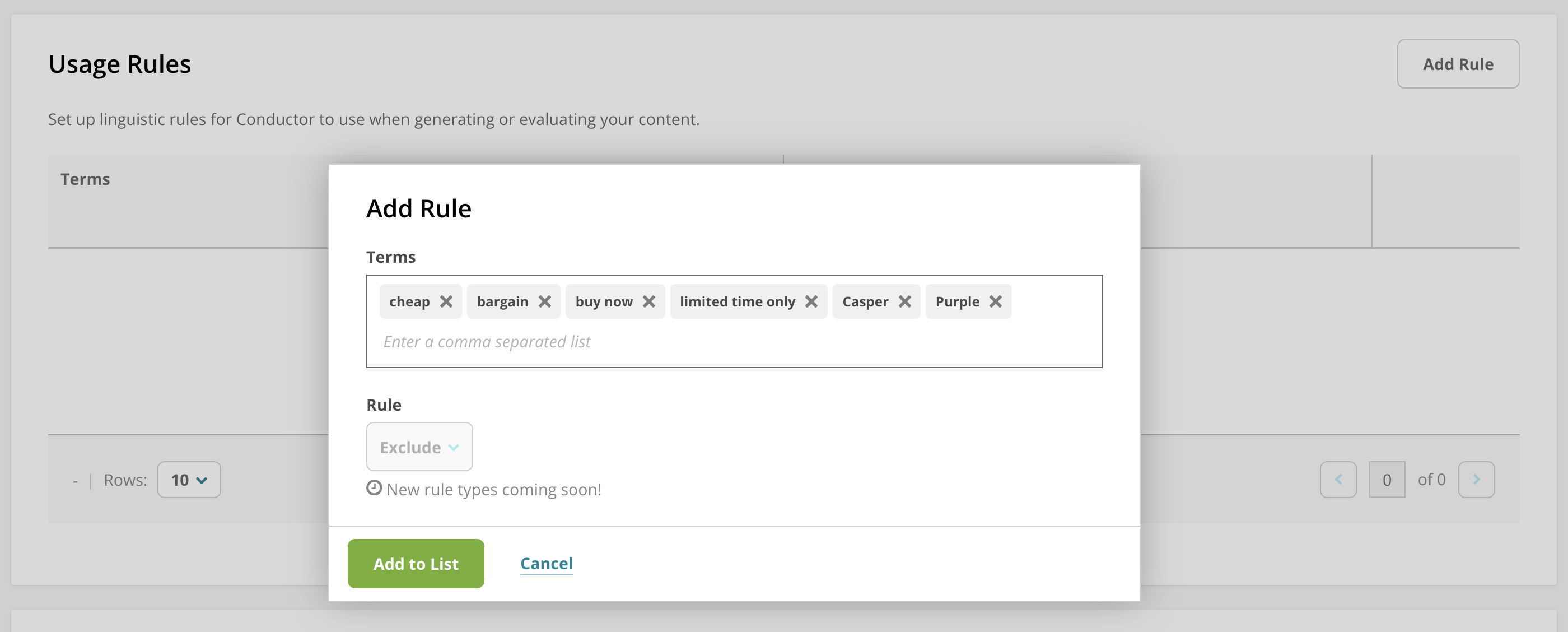
💬 Note: While the system is continuously improving to increase compliance, it's always a best practice to have a human review AI-generated content.

If you've reviewed the steps above and are still struggling with a blank page, don't worry. You can use generative AI as a creative partner to help you brainstorm and articulate your brand's identity.

Here are some tips and tricks, complete with prompts you can copy and paste, to get started.
🤖 Use AI to Define Your Voice and Tone
1️⃣ Gather Your Raw Materials: Collect your company's website URL, your official mission statement or "About Us" text, and links to 2-3 pieces of content that you feel truly represent your brand.
2️⃣ Use this Prompt: Copy and paste the following prompt into your company-approved generative AI tool, filling in the bracketed information.
Act as a brand strategist. I need help creating a "Voice and Tone" guide for my company. Analyze the provided information and generate a guide that includes:
1. A list of 5-10 adjectives that describe the brand's voice.
2. A summary paragraph describing the overall voice, tone, and personality.
3. A few "Do and Don't" examples for writing.

Here is the information about my brand:
- Website: [Insert your website URL here]
- Mission Statement/About Us: "[Paste your mission statement or 'About Us' text here]"
- Content Examples I Like:
  - [Paste link to your first content example]
  - [Paste link to your second content example]
  - [Paste link to your third content example]
3️⃣ Review, Refine, and Use: The AI will provide a detailed description of your voice and tone. Review the output and edit any parts to better match your vision. Once you're happy, copy and paste it into the Voice and Tone section of your Content Profile in Conductor.
🤖 Use AI to Describe Your Audience
1️⃣ Gather Your Raw Materials: All you need is a clear and simple description of your product or service.
2️⃣ Use this Prompt:
Act as a market researcher. I need help creating a detailed audience persona for my company. Based on the product/service I describe below, please generate a persona that includes:
1. A name and a role/title.
2. Their primary goals and motivations.
3. Their key challenges and pain points.

My company's product/service is: [Describe your product or service in 1-2 sentences. For example, "We offer a project management software for small creative agencies to help them track time and manage client feedback."]
3️⃣ Review, Refine, and Use: The AI will create a comprehensive persona. Adjust it to better reflect your actual customer base, then paste this into the Audience section of your Content Profile.
🤖 Use AI to Brainstorm Your Usage Rules
1️⃣ Use this Prompt:
Act as a content governance specialist. I am creating a list of "Terms to Exclude" for my brand's content. Help me brainstorm the types of words or phrases I should consider adding to this list.

Please provide me with a list of questions to think about, with examples, for the following categories:
- Outdated Brand or Product Names
- Competitor Information
- Industry Jargon to Avoid
- Language that might have legal implications
- Language that doesn't match our brand voice
2️⃣ Answer the Questions and Create Your List: This prompt will give you a framework for building your exclusion list. Use the questions to guide an internal discussion and create a definitive list to add to the Usage Rules section of your Content Profile.

Once your Content Profiles are created, using them is simple:
Start a new draft in Writing Assistant ↗️.
Select the appropriate Content Profile as one of the initial steps. This will happen before you generate any text.
Generate your draft. The AI will now use the guidelines from your selected profile to create a draft that aligns with your brand. If you need to provide specific, one-off instructions for a particular piece of content, you can still use the "Additional Instructions" field.
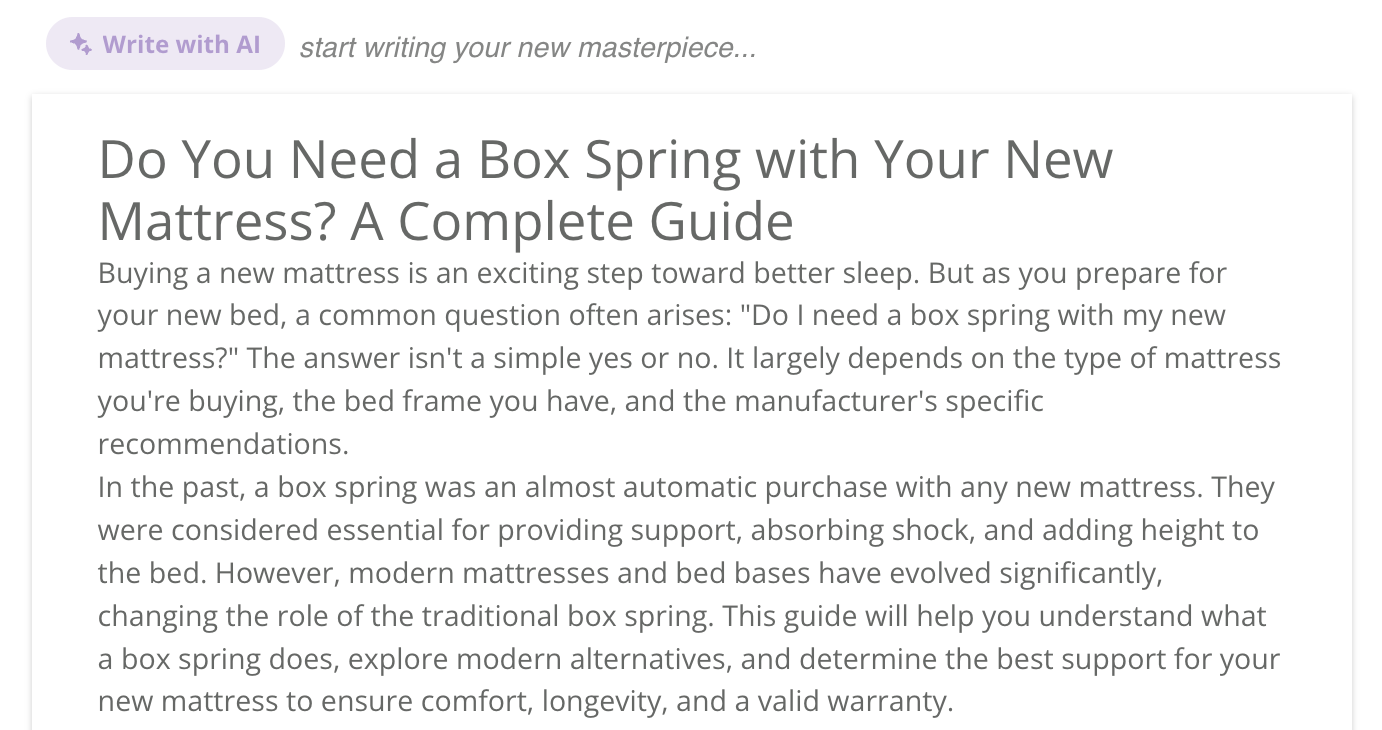
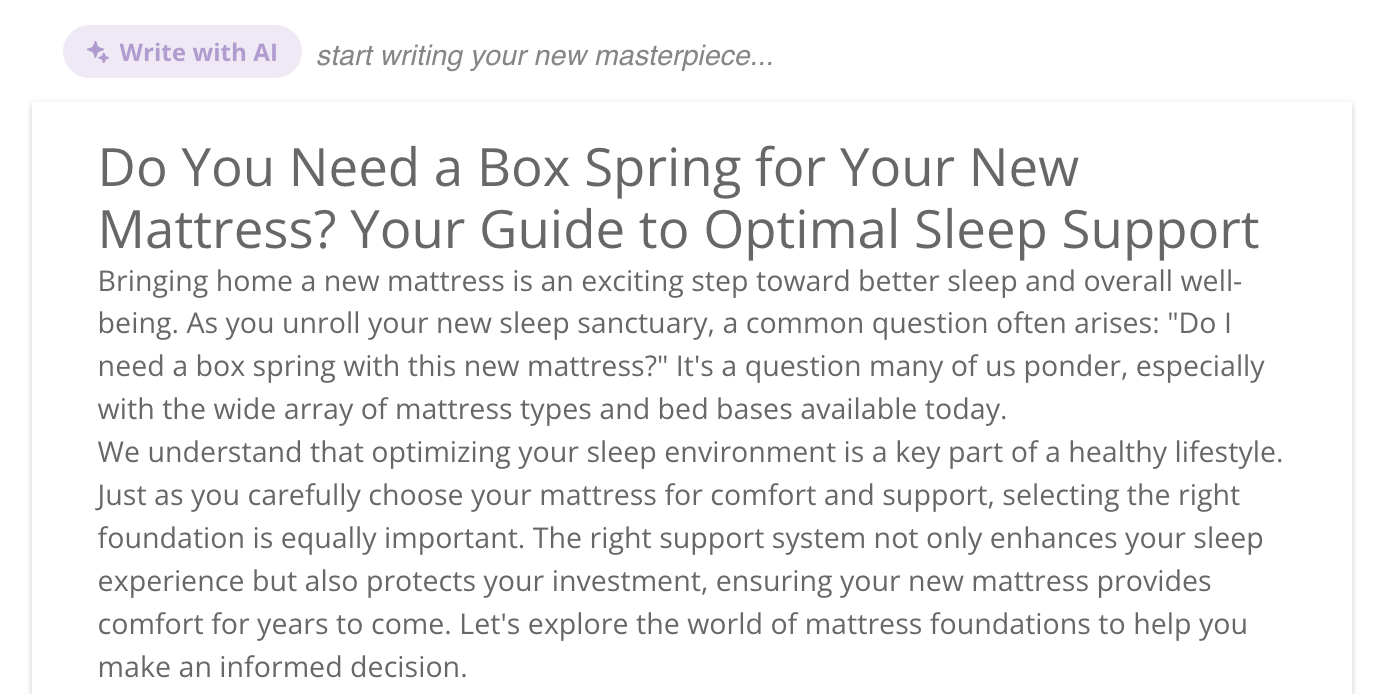
Just look at the stylistic difference between the opening statements of these two drafts, both targeting "Do I need a box spring with my new mattress," with and without a Content Profile applied...
❌ No Content Profile applied (generalized audience, style is more generic):
✅ "Proactive Wellness Seeker" Content Profile applied (language and tone is targeted to a particular audience with specific interests and needs):
By investing a small amount of time to create thoughtful and detailed Content Profiles, you'll empower your team to create high-quality, on-brand content with greater speed and consistency than ever before.
Get trained on the full topic ideation → content generation workflow:
Level-up with this guide:
Make the most of your Writing Assistant trial:
Stay up-to-date with the latest feature updates:

💡 Have an idea for how we could improve? Share any product feedback you have! 💡